Shore 00–30 Demystified: Soft Silicone Secrets, Expert Comparison & Demolding Troubles Solved
Look, I'll be honest. When I first started casting toys in Hong Kong, I thought Shore hardness was just some nerdy engineer thing I could ignore. Then I ripped three tentacle molds in a row and burned through HK$400 in platinum silicone. That's when I learned: if you're working anywhere near Shore 00–30, you're playing in the most unforgiving zone of silicone casting. Too soft to hold detail, too sticky to demold cleanly, and absolutely brutal on beginners who think they can just pour and pray.
This isn't some academic overview. I'm going to walk you through exactly what Shore 00–30 means, why it matters for anyone casting soft props or toys, and—most importantly—how to stop wasting money on batches that tear like wet tissue paper.
What is Shore Hardness?
Shore hardness is how we measure how soft or hard a rubber or gel feels when you press into it. The system was invented by Albert Ferdinand Shore in the 1920s because industrial manufacturers needed a consistent way to compare materials. Before that, people would just poke things and say "yeah, feels about right." Not exactly scientific.
A durometer is the tool that measures this. Think of it like a specialized scale that doesn't measure weight—it measures resistance to indentation. You press the probe into the material, and the gauge tells you a number from 0 to 100. The catch? There are multiple Shore scales, and Shore 00 exists specifically because regular scales couldn't handle ultra-soft materials.
Here's the thing most guides won't tell you: Shore 00 was created because Shore A bottoms out below 20. When you're working with materials softer than a gel insole, Shore A just reads "too soft to measure accurately." That's where Shore 00 comes in. It uses a different probe geometry—a blunter, truncated cone instead of a sharp point—and a lighter spring force. This lets you differentiate between "marshmallow soft" and "memory foam soft" in a meaningful way.
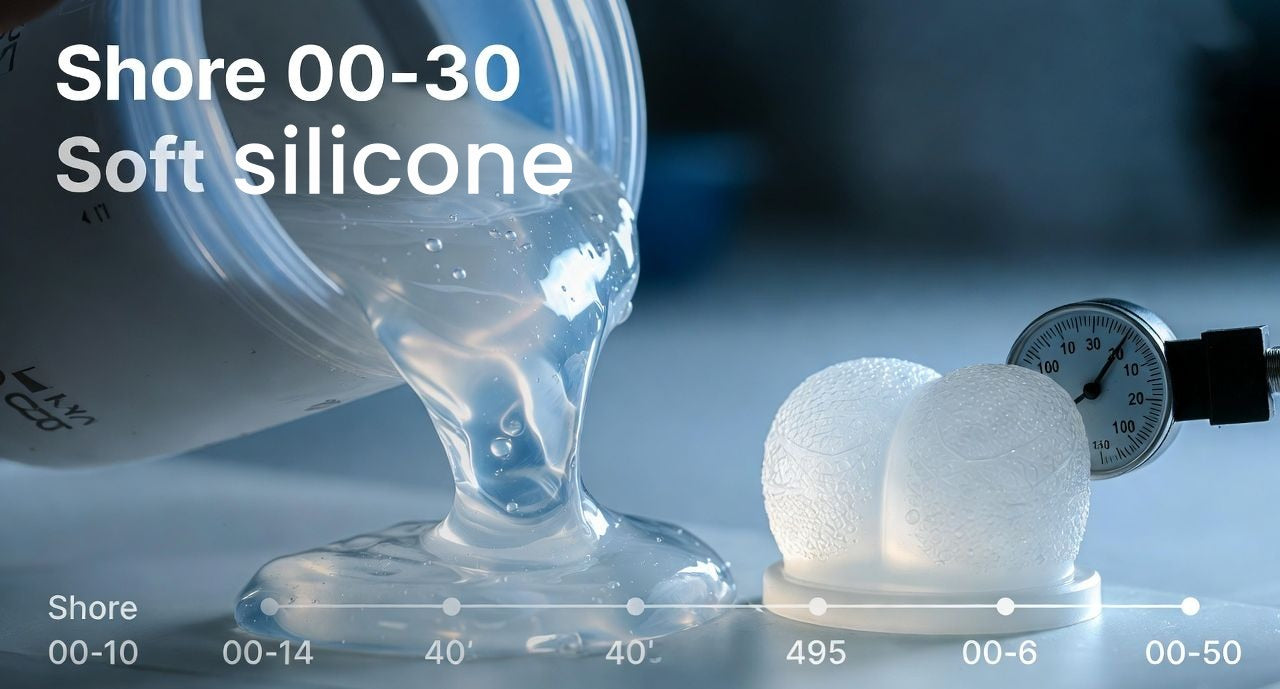
The Shore 00 scale runs from 0 (basically liquid) to 100 (which overlaps with Shore A 50-ish). So when you see something rated Shore 00–30, you're looking at materials in the "gel cushion to soft gummy bear" range. Stupid soft. Floppy. Exactly what you want for lifelike toys or prosthetics, but a nightmare to work with if you don't know the tricks.
Comparison of Shore Hardness Scales: 00, A, and D
Most people get confused because there are three main Shore scales, and they overlap in weird ways. Let me break it down with stuff you can actually touch.
Shore 00 (0–100): This is the ultra-soft zone. Think gel insoles at Shore 00–30, silicone breast implants around 00–20, or those squishy stress balls at 00–40. If it jiggles when you poke it and takes a second to spring back, it's probably Shore 00 territory.
Shore A (0–100): This is the general-purpose rubber scale. Rubber bands sit around Shore A 25, pencil erasers at A 40, shoe soles at A 60, and car tires at A 70. Most of the silicone you'll encounter in daily life—phone cases, kitchen spatulas, O-rings—lives in Shore A 40–80.
Shore D (0–100): This is for rigid plastics and hard rubbers. Ski boots, hard hat shells, bowling balls. If it's hard enough that you can't dent it with your thumbnail, it's probably Shore D. A plastic credit card is around Shore D 80.
Here's where it gets messy: Shore 00–75 roughly equals Shore A 0–25. And Shore A 95 is about Shore D 50. The scales overlap because the probe geometry and spring force change. A Shore 00 durometer physically can't measure a car tire, and a Shore D durometer will just max out immediately on a gel insole.
In practical terms for toy casting: if you're making something that needs to feel like real skin or tissue, you're almost always in Shore 00–10 to Shore A 15. That's the sweet spot for lifelike squish. Anything firmer and it starts feeling like a dildo from 2005. Anything softer and you're into medical-grade gel territory that requires pressure casting to avoid bubbles.
Mold-Making Nightmares: Why Shore 00–30 Demolding Fails (and Solutions That Backfire)
This is where I lost the most money early on. You mix your Ecoflex 00–30 perfectly, pour it into a beautiful plaster mold, wait the full cure time, and then... it rips. Not just at the edges—straight through the thin sections. I've watched a guy on a Hong Kong maker forum lose his mind after his third failed tentacle cast: "Finally got my 00–30 mix to pour but it tore like tissue paper pulling it from the mold—wasted $50 on pigment for nothing, fucking infuriating."
Let's talk about why this happens and why the "obvious" fixes often make it worse.
Problem: The silicone sticks to the mold and tears during demolding.
Most beginners reach for household dish soap as a release agent. Makes sense, right? It's slippery. Wrong. Soap residue reacts with uncured silicone. Even if the surface feels set, there's still active chemistry happening in the first 24 hours. Soap leaves behind surfactants that interfere with the platinum catalyst, creating sticky spots. When you try to peel the cast out, those spots grip the mold while the rest releases, and you get a tear. I've done this. It sucks.
The fix that actually works: dedicated mold release like Mann Ease Release 200 or even petroleum jelly applied in a thin, even layer. The key word is thin. Glob it on and you'll get surface texture issues. Brush it on like you're painting a miniature, let it sit for five minutes, then wipe off any excess with a clean cloth.
How to Measure Shore 00–30: Tools, Calibration & Avoiding Common Errors
Most guides gloss over this, assuming you'll just buy a durometer and figure it out. That's how you end up with wildly inconsistent readings and no idea if your mix is actually Shore 00–30 or Shore 00–45.
First, you need a Shore 00 durometer, not a Shore A. They look similar but the probe geometry is completely different. A Shore 00 probe has a 2.4mm diameter truncated cone with a 0.1N spring force. A Shore A probe is sharper and uses 0.55N to 8N depending on the reading. If you try to measure Shore 00–30 material with a Shore A durometer, you'll get a reading around A 5–10, which tells you nothing useful.
Here's the measurement protocol I use in the JockTribe workshop:
The sample needs to be at least 6mm thick. Thinner than that and you're measuring the table underneath, not the silicone. Place the sample on a hard, flat surface—not your hand, not a soft mat. Press the durometer probe straight down until the base plate is flush with the material surface. Don't push harder. Don't angle it. The gauge will jump around for the first second as the spring compresses; read the value after 3 seconds when it stabilizes.
Take three measurements at different spots and average them. Shore 00–30 materials are often inconsistent because they're so soft that any air pockets, incomplete mixing, or thin spots will throw off the reading.
Common error: measuring freshly-cured silicone. Even after the manufacturer's stated cure time, Shore 00–30 materials continue to cross-link for another 24–48 hours. I've seen batches read Shore 00–25 at 24 hours and Shore 00–32 at 72 hours. If you're trying to hit a precise spec, wait three days before measuring.
Common error: measuring cold silicone. Temperature affects durometer readings. A cold sample (below 20°C) will read 5–10 points harder than the same sample at 23°C. If you store your cured pieces in a cool room and then measure them immediately, you'll think they're firmer than they actually are in use. Let the sample equilibrate to room temp for at least an hour.
Calibration: Your durometer should come with a test block. Check it every few months. If your Shore 00–30 test block is reading 00–35, your spring is weakening and every measurement you take is off by 5 points. Calibration isn't optional if you're doing this professionally.
Everyday Examples of Shore 00–30 Materials & Where They're Actually Used
Let's ground this in stuff you can actually touch, because abstract numbers mean nothing until you've held the material.

Shore 00–10: Silicone gels, ultra-soft breast implants, high-end prosthetic skin. This is "almost liquid" territory. If you press your thumb in, it takes 2–3 seconds to fully spring back. In toy casting, this is the range for ultra-realistic dildos that mimic the exact give of real tissue. It's also the range for medical wound dressings and gel insoles designed for diabetic patients who need maximum cushioning.
Shore 00–20: Gummy bears, makeup sponges, soft cushioning pads. This is the "squishy but holds its shape" zone. A gummy bear is usually Shore 00–15. Silicone casting molds for chocolate or soap are often in this range because they need to release easily without tearing. In adult toys, this is the sweet spot for strokers and soft sleeves that compress easily but don't collapse.
Shore 00–30: Gel insoles, softer rubber gaskets, flexible vibration dampeners. This is where most "soft-touch" consumer products live. The gel heel cup in your running shoes is probably Shore 00–28. O-rings for low-pressure applications (like water bottle caps) are often Shore 00–30 because they need to compress easily without much force. In toy design, this is the firmness I use for textured surfaces and flexible bases that need to grip smooth surfaces without suction cups.
Shore 00–40 and up: Pencil erasers, soft rubber bands, basic silicone spatulas. Once you're above Shore 00–35, you're overlapping with Shore A 10–15, and you're out of the "ultra-soft" category. This is regular soft rubber. Useful, but not what we're focusing on here.
The reason Shore 00–30 is so popular in prosthetics and special effects is because it mimics the compression resistance of human fat and muscle tissue. When you press into someone's thigh, it gives way slowly, then rebounds. That's Shore 00–20 to 00–30. Firmer and it feels fake. Softer and it feels like pressing into raw meat, which is... not the vibe most people are going for.
Shore 00–30 in Industry: Medical, Prosthetic, and Future Innovations
Outside of toy casting and prop making, Shore 00–30 materials are doing some genuinely impressive work in fields most people never think about.
Medical applications: Soft silicone in the Shore 00–20 range is used for wound dressings that conform to irregular body surfaces without creating pressure points. The material needs to be soft enough that it doesn't restrict blood flow, but firm enough to stay in place and protect the wound. Newer formulations in 2025 are incorporating antimicrobial additives that slowly release silver ions, which prevents infection without needing to change the dressing as frequently.
Prosthetics: High-end prosthetic limbs now use multi-durometer silicone skin, where the surface layer is Shore 00–10 for realistic compression, backed by a firmer Shore A 20 layer for structural support. This lets the prosthetic "give" when you shake someone's hand or bump into something, which makes it feel more natural. The challenge is durability—Shore 00–10 silicone tears easily, so manufacturers are experimenting with fabric reinforcement embedded between layers.
Soft robotics: This is where it gets wild. Researchers are building robots with Shore 00–30 silicone actuators that can grip delicate objects like fruit without bruising them. The soft material compresses around irregular shapes, distributing force evenly. Some designs use pneumatic bladders cast in Shore 00–20 silicone that inflate and deflate to create movement. The ASTM D2240-00 standard is being updated to include testing protocols for silicones that undergo millions of compression cycles, because these robots need to work reliably for years.
Consumer products: The "soft-touch" trend in product design is driving demand for Shore 00–30 coatings on everything from tool handles to phone cases. The issue is that most Shore 00–30 materials are silicone or TPE, which are expensive and hard to bond to rigid substrates. New hybrid polymers are being developed that hit Shore 00–30 but can be injection-molded onto plastic cores in a single step, which would make soft-touch products way cheaper to manufacture.
One thing to watch: bio-based silicones are starting to hit the market, made from renewable feedstocks instead of petroleum. They're not quite at price parity yet, but if you're casting toys for an eco-conscious market, this might be a differentiator in the next few years.
Why Platinum Beats Tin (Except When It Doesn't): Curing Myths for Shore 00–30
The conventional wisdom is simple: platinum cure is better. It doesn't yellow, it's more stable, it's body-safe, and it's what every professional uses. All true. But here's the part most guides won't tell you: platinum cure is a pain in the ass with Shore 00–30 materials, and sometimes tin cure is the smarter choice.
Platinum cure advantages: No yellowing over time, no odor, excellent long-term stability, and it's the only option if you're making body-safe toys. The cross-linking chemistry is more controlled, so you get consistent Shore hardness batch to batch. For anything that touches skin, especially mucous membranes, platinum cure is non-negotiable.
Platinum cure problems: It's inhibited by sulfur, latex, and some pigments. If you're casting into a plaster mold that has sulfur-based release agents, your platinum cure silicone might not cure at all. Just stays liquid forever. I've had this happen with Smooth-On Dragon Skin poured into a mold that was prepped with a sulfur-based clay. Total loss. Platinum cure is also picky about mixing ratios—if you're off by more than 5%, you'll get incomplete cure or tacky spots.
Tin cure advantages: Cheap, fast, and it doesn't care about sulfur contamination. You can pour tin cure silicone into almost any mold and it'll cure. It also tolerates higher pigment loads—up to 10% by weight—without affecting cure. For opaque props where you don't care about yellowing, tin cure can save you 40% on material costs.
Tin cure problems: It yellows over time, especially in UV light. It has a stronger odor during cure. And most importantly, it's not body-safe. The tin catalyst can leach out over time, and while it's not acutely toxic, it's not something you want in prolonged contact with skin. For display props or costumes, fine. For toys, absolutely not.
Here's where the debate gets messy: some makers use tin cure silicone for molds and platinum cure for the final cast. This works because the tin cure mold is just a tool, not the final product. But you have to be careful—if any uncured tin catalyst is on the mold surface, it can inhibit the platinum cure in contact with it. Best practice is to fully post-cure tin molds (bake them at 80°C for 4 hours) before using them with platinum cure materials.
My workshop rule: platinum cure only for anything body-contact, tin cure for structural molds and non-contact props. And if I'm adding pigments or additives, I do a small test batch first to make sure the cure isn't inhibited. I learned this the expensive way. Click here to view our Material Safety Certificates.

Conversion Charts: Shore 00, Shore A, D, and Beyond
One of the most frustrating things about Shore hardness is that the scales overlap but don't convert linearly. A Shore 00–50 material is roughly Shore A 15, but there's no simple formula. The relationship is logarithmic because the probe geometry and spring force change between scales.
Here's a practical conversion table based on ASTM D2240-00 and real-world testing:
| Shore 00 | Shore A (approx | Shore D (approx | Example Material |
| 10 | — | — | Silicone gel, gummy candy |
| 20 | — | — | Soft breast implant, makeup sponge |
| 30 | — | — | Gel insole, soft gasket |
| 40 | 5–10 | — | Pencil eraser, soft rubber band |
| 50 | 10–15 | — | Silicone spatula, soft phone case |
| 60 | 15–20 | — | Rubber band, soft O-ring |
| 75 | 25 | — | Shoe sole, firm eraser |
| — | 50 | — | Skateboard wheel, hard eraser |
| — | 70 | 20 | Car tire, hard shoe sole |
| — | 95 | 50 | Hard plastic, ski boot shell |
The key thing to understand: you can't accurately measure Shore 00 with a Shore A durometer. The scales are designed for different material ranges. If you try to measure a Shore 00–30 gel with a Shore A durometer, the reading will bottom out at A 0–5, which tells you nothing useful.
Also, these conversions are approximate. Two materials with the same Shore hardness can feel completely different because Shore only measures compression resistance, not tear strength, rebound resilience, or tensile strength. A Shore 00–30 silicone and a Shore 00–30 TPE gel will have totally different handling characteristics even though the durometer says they're the same.
If you're spec'ing materials for a project, don't rely on Shore hardness alone. Get samples and test them in your actual use case. I've wasted too much money ordering materials based on Shore ratings that felt nothing like what I expected in practice.
How do I stop my Shore 00–30 tentacle from ripping at the suckers when I peel it out of the plaster mold?
Thin details like suckers tear because they're the last part to cure and the first part to experience stress during demolding. First, make sure your mold release is applied evenly—I use Mann Ease Release 200 brushed on thin, let it dry for 10 minutes, then apply a second coat. Second, change your demolding technique: don't peel from the edge. Instead, use a thin plastic wedge (I cut strips from old credit cards) to gently lift the edge, then work compressed air under the silicone to break the seal. This distributes force evenly instead of concentrating stress on thin sections. Third, if you're still getting tears, your silicone might be under-cured. Extend cure time by 50% and keep the mold in a warm room (25°C) to ensure full cross-linking before demolding.
What's the exact ratio of Ecoflex 00–30 parts A/B if I'm adding 5% Th-Vex for veins without messing up the cure?
Ecoflex 00–30 is 1:1 by volume, so if you're doing 100g total, that's 50g Part A and 50g Part B. Adding 5% Th-Vex means 5g of thickener added to the combined A+B mix, so your total is 105g. Here's the order that matters: mix A and B together first, degas if you're using a vacuum chamber, then add the Th-Vex and stir gently. Don't degas again after adding Th-Vex or you'll pull it back out. The Th-Vex will slow the cure slightly—expect 6–8 hours instead of 4. If you're also adding pigment, add it to Part A before mixing with Part B, and keep total additives (pigment + Th-Vex) under 8% by weight. Above that, you risk incomplete cure. Watch for cure inhibition by doing a thumb test at 24 hours—if it's still tacky, you've overloaded the mix.
Safe way to store uncured Shore 00–30 batches without them starting to cure prematurely in the bottle?
Platinum cure silicones start cross-linking the moment Part A and Part B touch, so you can't store mixed batches. What you can do is store Part A and Part B separately in airtight containers with minimal headspace. I use squeeze bottles with cone tips, purge the air out before sealing, and store them in a cool, dark place (15–20°C). Humidity is the enemy—moisture in the air can start reacting with Part B over time, making it thicker and harder to mix. If you're in a humid climate like Hong Kong, consider using desiccant packs in your storage area. For long-term storage (6+ months), some people use nitrogen blankets, but that's overkill unless you're buying in bulk. And never, ever let Part A and Part B contaminate each other—even a drop of Part B in your Part A bottle will start the cure. Use separate measuring cups and stir sticks.
Why does my Shore 00–30 feel perfect floppy at first but crack at seams after a few flexes?
This is almost always a seam prep issue or an over-softened mix. If you're doing a multi-part mold, the seam is where two pours meet, and it's the weakest point. Make sure the first pour is fully cured before adding the second—if it's still tacky, the new silicone won't bond properly and you'll get delamination. Rough up the seam line with 220-grit sandpaper and wipe it with isopropyl alcohol before the second pour. This gives the new silicone something to grip. If the crack is happening at stress points (like where a tentacle bends), you might need fabric reinforcement—cut a strip of nylon mesh, embed it in the first pour, let it cure, then do the second pour over it. The mesh distributes stress and prevents crack propagation. And if you've added softener to hit Shore 00–30, you've probably compromised the cross-link density. Use a material formulated for that hardness instead of hacking a firmer silicone.
Bubbles everywhere in my 00–30 pour even after 20 min vac—it's like the shit eats air or something.
Shore 00–30 materials have low viscosity, which means bubbles rise slowly and new bubbles form easily during pouring. Here's what actually works: degas your mixed silicone for 10–15 minutes max, then pour in a thin stream from a height of about 30cm into the lowest point of the mold. The thin stream breaks surface tension and lets bubbles escape as you pour. Don't pour directly into detail areas—let the silicone flow into them naturally. After pouring, use a pressure pot at 40–60 PSI during cure. The pressure compresses bubbles so small they're invisible. If you don't have a pressure pot, try this: after pouring, mist the surface with isopropyl alcohol from a spray bottle. The alcohol breaks surface tension and pops surface bubbles. It's not as effective as pressure, but it helps. And check your mixing technique—if you're whipping the silicone like cake batter, you're incorporating air. Fold it gently with a spatula, scraping the sides and bottom to ensure thorough mixing without aeration.
Article Editor:
JockTribeRoger, Co-Founder & Lead Designer
Check out our comprehensive guide to dildo materials and stiffness;