Platinum Silicone vs. Everything Else: Why I Refuse to Compromise
The Designer's Constraint
Where Design Actually Begins
Let me be blunt: I don't "choose materials." I run an exclusion experiment. Anything that isn't completely biologically inert at 37.5°C gets eliminated before I think about form or aesthetics.
This industry trains consumers to accept "silicone" as a catch-all term. Walk into any store and you'll find "medical-grade silicone" that's actually TPE with a glossy finish. The confusion isn't accidental—it's profitable.
The Molecular Difference
When Chemistry Becomes an Ethical Choice
The difference between tin-cure and platinum-cure systems is the difference between "good enough for a spatula" and "safe for prolonged skin contact."
| Factor | Tin-Cure Silicone | Platinum-Cure Silicone |
|---|---|---|
| Catalyst | Tin (Sn) compounds | Platinum (Pt) complex |
| Byproducts | Acetic acid, alcohol vapors | None — no volatile byproducts |
| Thermal Stability | May degrade around 200°C; softens over time | Stable across body temperature range (20–40°C); service temperature up to ~200°C |
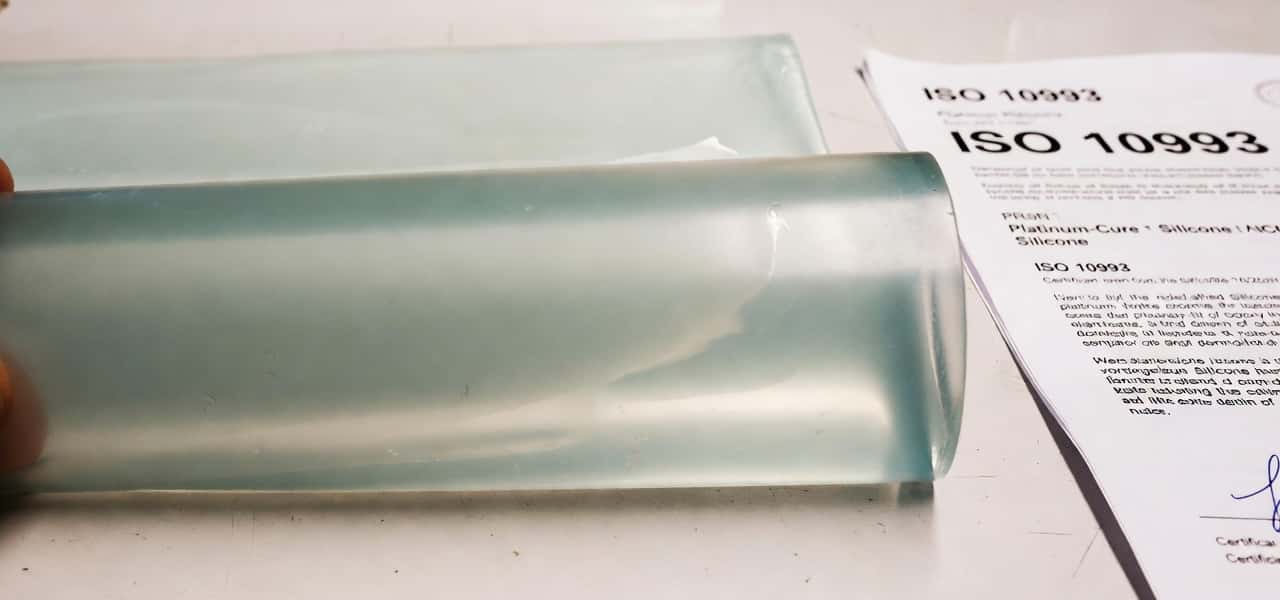
| Certifications | Limited biocompatibility testing | ISO 10993, USP Class VI compliant |
What this means in practice:
- You can sterilize with boiling water, alcohol, even autoclave cycles—no leaching
- After 100 wash cycles at 60°C, maintains Shore A hardness within ±2 points
- No peroxide residues, no tin salts—just stable cross-linked polymer

The Myth of "Realistic" TPE
The Hidden Cost of "Skin-Like" Feel
TPE gets marketed as "ultra-realistic" because it feels soft and skin-like. The problem? That realism comes from plasticizers migrating to the surface.
The Structural Problem
- TPE has a porous microstructure—like a sponge at the microscopic level
- Plasticizers fill these pores to keep material soft, but leach out over time
- As they migrate, material stiffens and pores absorb bacteria, sweat, bodily fluids
⚠️ The paradox: Softer TPE = more plasticizer = faster degradation. By month 3, that "skin-like" texture becomes a sticky, discolored mess you can't fully sanitize.
Platinum silicone? Zero porosity. Nothing absorbs. Everything stays on the surface where you can actually clean it.
Manufacturing Reality
Why Nobody Else Does This
Choosing platinum-cure silicone is economically masochistic:
- Raw material cost: 3-5x higher than TPE
- Curing time: 8-12 hours vs 2 hours for tin-cure
- Requires cleanroom-level air filtration (platinum catalysts poisoned by contamination)
- Rejection rate: ~15% higher from contamination failures
But I didn't start JockTribe to optimize units shipped per quarter. I started it because I was tired of products that treated my body like a testing ground for cost engineering. Using platinum silicone is something I've always valued, which is why JockTribe is better than other products.
Roger's Verdict
Form is always a function of material.
You can engineer perfect contours and dual-density layers. But if the substrate leaches plasticizers into tissue, none of it matters.
Material safety isn't a checkbox. It's the physical truth your body experiences—on day 1, month 6, and year 3 when the product still performs exactly as designed.
Platinum-cure silicone isn't the "premium option." It's the baseline requirement for anything that deserves to be near your body. This article was written by Roger from JockTribe, who designs and develops products specifically for JockTribe.

FAQ
How can I tell if a product uses real platinum-cure silicone?
Ask for ISO 10993 or USP Class VI certification. If a brand cannot provide certification within 24 hours, it is unlikely to be true platinum-cure silicone. Genuine platinum silicone has no noticeable odor and does not become sticky over time.
Why don't more brands use platinum-cure silicone?
Platinum-cure silicone is significantly more expensive and complex to manufacture. It requires cleanroom production standards, longer curing times, and raw materials that can cost three to five times more than standard alternatives. Many brands prioritize production margins over material quality.
Can I sterilize platinum silicone products?
Yes. Platinum-cure silicone can safely withstand boiling water, 70% isopropyl alcohol, UV sterilizers, and even autoclave cycles. This durability is one reason it is widely used in medical-grade applications and implants.
Scientific References
Anyszka, R., et al. (2020). Platinum-Catalyzed Hydrosilylation in Polymer Chemistry. Polymers, 12(10), 2174.
https://doi.org/10.3390/polym12102174
ScienceDirect Topics. Condensation Cure Silicone – Overview.
https://www.sciencedirect.com/topics/engineering/condensation-cure-silicone
Wikipedia. Silicone.
https://en.wikipedia.org/wiki/Silicone
Wikipedia. Thermoplastic Elastomer.
https://en.wikipedia.org/wiki/Thermoplastic_elastomer
Plasma.com. Thermoplastic Elastomers (TPE).
https://www.plasma.com/en/plasma-technology-glossary/thermoplastic-elastomers-tpe/
Linn Materials. What to Do When TPE Elastomer Materials Become Sticky?
https://www.tpe123.com/what-to-do-when-tpe-elastomer-materials-become-sticky/
Anyszka, R., et al. (2024). Leaching of Catalyst Platinum from Cured Silicone Elastomers.
https://www.sciencedirect.com/science/article/pii/S0304386X24000239
United States Pharmacopeia. <1031> Biocompatibility.